Your assignment
Produce an evidence-backed audience brief and a decision to test or revise. Use your own project, or practice with the clearly illustrative compact-desk-lamp scenario.
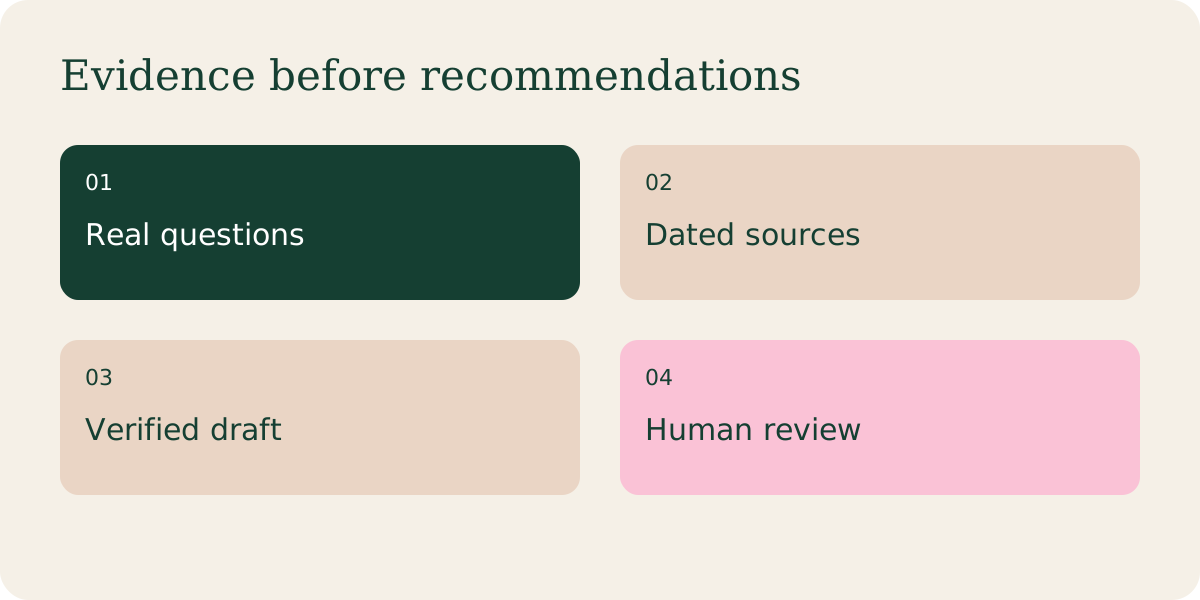
Step by step
List three audiences you understand and a recurring buying decision for each. Score personal knowledge, access to buyers, ability to test products and available programs from 1–5. Use scores to expose assumptions, not claim market size.
Collect ten real questions from interviews, permitted public discussions or your own search data. Save URLs and dates; remove identifying information before giving notes to AI.
Ask AI to group the questions by task, constraint and objection. Build a provisional persona around a situation: what triggers the purchase, what matters, what prevents action. Never present generated personas as real customers.
Check demand manually: inspect relevant search results, competing explanations, retailer options and current program eligibility. Keyword-tool estimates are directional. A model cannot invent reliable volume or sales forecasts.
Validate with three to five conversations and one useful prototype or article. Ask what the person last tried and what was difficult. Record actual behavior separately from polite enthusiasm. Choose a predeclared next step if evidence remains weak.
Try this prompt
Replace bracketed inputs with your real notes. Keep sensitive information out.
Using only these anonymized notes [notes], group repeated buying questions. For each group provide source IDs, buyer situation, desired outcome, constraint, objection and missing evidence. Label inference and uncertainty. Suggest five neutral interview questions and one inexpensive validation experiment.
A worked example
Illustrative persona: a renter with a 30-inch desk who needs evening task lighting without glare. This is more actionable than “women aged 25–45 who like home decor.”