Your assignment
Write a test plan and interpret results without declaring false winners. Use your own project, or practice with the clearly illustrative compact-desk-lamp scenario.
Step by step
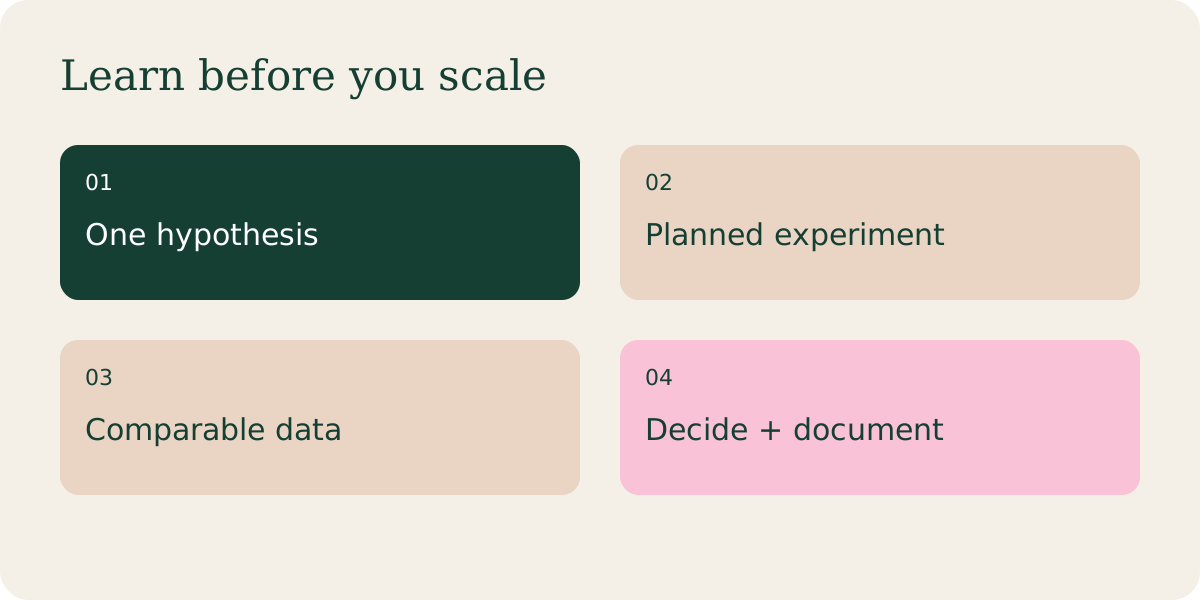
Identify one problem from behavior: weak qualified clicks, confusing comparisons or a missed disclosure. State a hypothesis before asking AI for variants.
For a real A/B test, randomly assign eligible visitors to concurrent variants and change one meaningful element. Set the primary metric, guardrail, minimum detectable effect, sample requirement and duration before starting. Use an appropriate statistical tool or specialist to determine sample needs.
If traffic is too low, use interviews and usability sessions first. Sequential social posts are exploratory comparisons, not controlled A/B tests: audience, timing and distribution differ.
Ask AI to check an anonymized export for missing data, inconsistent windows and denominator mistakes. Keep impressions, visits, affiliate clicks, attributed orders, pending commissions and approved commissions distinct.
Review at the planned endpoint rather than stopping when results look favorable. Report uncertainty and inconclusive outcomes. Commission approvals can lag; evaluate costs and reversals before scaling.
Try this prompt
Replace bracketed inputs with your real notes. Keep sensitive information out.
Review this experiment plan [plan] and anonymized results [data]. Check randomization, comparable windows, metric definitions, sample adequacy, missing values and confounders. Calculate only supported rates, showing numerator and denominator. Do not declare a winner from insufficient data. Recommend continue, revise or stop with explicit uncertainty.
A worked example
Illustrative arithmetic, not a result: A has 12 clicks/200 visits = 6%; B has 16/200 = 8%. That is a 2-percentage-point observed difference, not proof of a real lift. Statistical uncertainty and the test design still matter.